Artikel Opini | BETWEEN GUNS AND VOICES: VIOLENCE BY THE AUTHORITIES AND THE HUMAN RIGHTS CRISIS IN PAPUA
Author: Melinda Rahmasari
Student of International Relations, UNESA
Batch 2024
In Papua, the main problem is no longer the lack of infrastructure development but the state's failure to protect the right to life of its citizens. When four students in Paniai were shot dead and the perpetrator was acquitted by the court, the state's message became clear that “justice is not for all”. Violence by the authorities takes place without clear legal consequences, and human rights are victimized in the name of security.

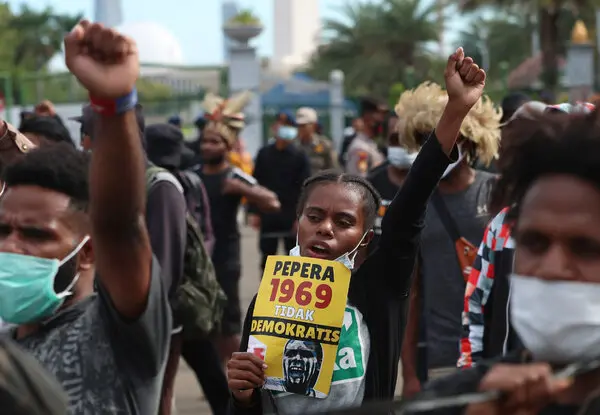
Source: New York Times (https://www.nytimes.com/2020/12/12/world/asia/west-papua-independence.html)
Papua has always been the paradoxical face of Indonesia. On the one hand, the region is rich in natural resources and stunning beauty, but on the other hand, it is a dark space for endless human rights abuses. In this land promised of justice and prosperity, the voices of the people are often drowned among the echoes of guns, security operations, and promises of development that never fully touch the roots of their lives.
Over the years, stories about Papua have always led to suffering. The suffering that arises is not just from a single incident, but from a pattern of violence that continues to be repeated, as if it is part of the social and political structure in this area. Violence by the authorities against civil society and indigenous peoples is not only caused by certain individuals, but also by a system that allows violations without accountability. This is where the human rights problem in Papua lies, a structural failure that prioritizes peace over humanity.
Papua and the shadow of militarization
Since its integration into Indonesia in 1969 through Pepera (People's Opinion Determination), Papua has always been viewed by the state through the lens of security. While other regions talk about autonomy and well-being, Papua talks about armed patrols, military posts, and security operations. This military approach shaped a terrifying social reality for many citizens. Such a strong militarization arouses suspicion of civilians. Indigenous Papuans are branded as separatist sympathizers simply because they talk about their basic rights.
In the past two decades, reports have shown a recurring pattern of violence, including shooting of civilians, torture, eviction of indigenous peoples from their land, and restrictions on the movement of activists and journalists. Many cases are not resolved transparently, creating a culture of deep impunity. The Human Rights Monitor report in 2024 noted that at least more than 200 cases of violence by the authorities against civilians in Papua have not received adequate legal resolution. This condition is exacerbated by weak access to justice, limited press freedom, and stigma against Papuans who are often suspected of being part of a separatist movement simply because they demand their basic rights.
The Paniai tragedy: a recurring symbol of impunity
One of the tragedies that best illustrates human rights issues in Papua is the shooting case in Paniai in December 2014. At that time, four students were shot dead by security forces during a protest over the violence experienced by a young man the day before. They are still teenagers, aged between 17 and 18 years. However, eight years later, after a long and stressful process, the human rights court against the only defendant ended in a free verdict.
For the victims' families, the verdict is not the end of the struggle, but concrete proof that the law is not on their side. The court failed to unravel the chain of command and did not touch the main perpetrator. For many Papuans, the Paniai case is a symbol of impunity proving that the lives of indigenous Papuans do not have the same value in the eyes of the law. What's more painful, Paniai is not the only one. The cases of Wasior (2001), Wamena (2003), and Nduga (2018) show a similar pattern, of violence by the authorities, torture, extrajudicial killings, and expulsion of residents from their villages.
This represents a serious violation of international human rights standards as set out in the International Covenan on Civil and Political Rights (ICCPR). Under ICPR 6 (1), the state has an obligation to protect the right to life which is reinforced in General Comment No.36 which prohibits the arbitrary deprivation of life by state civil servants. The use of firearms against unarmed students who are peacefully protesting also violates Article 21 of the ICCPR on freedom of assembly and demonstrates the state's failure to provide effective legal remedies as stipulated in ICCPR 2 (3) and General Comment No. 31. Not only that, but the state’s failure also to effectively investigate, uncover the chain of command, and punish the perpetrators is a violation of the state's obligation to prevent impunity as stipulated in Articles 3, 6, 11, 12, and 24 of the ICCPED. This case shows the structural failure of the state in fulfilling its obligations for accountability and human rights protection.
Failure to hold accountability and loss of trust
The central government often emphasizes that Papua is a priority for national development. Roads were built, airports were expanded, and investment went into the mining, palm oil, and infrastructure sectors. However, behind the jargon of "Papua Bangkit", many indigenous peoples feel marginalized. Development in Papua often does not involve local communities in the decision-making process. In many cases, the presence of armed forces is used to secure economic projects, not to protect citizens. As a result, tensions increased, and violence recurred. This paradox shows that development that does not respect human rights deepens social wounds, not heals them.
The saddest thing about human rights issues in Papua is the disappearance of public trust in the state. Whenever there is violence, a report is made, an official statement is delivered, and a promise of an investigation is announced. But the results are almost always the same where the perpetrators are not properly prosecuted or only receive light administrative sanctions. This culture of impunity has become a vicious circle that undermines justice. When the law doesn't work, people stop hoping. As a result, tensions continue to build, and each new generation inherits a sense of distrust of the government. This is not only a legal issue, but also a matter of humanity and the integrity of the nation.
Hope that has not been extinguished
Although the situation seems bleak, there is still hope in Papua. Many local activists, religious leaders, journalists, and indigenous women continue to struggle amid threats. They became the voice of the unheard, fighting for the truth even at the risk of losing their freedom and even their lives. The presence of institutions such as Komnas HAM, churches, and civil society organizations is an important support for this struggle. But their struggle will be in vain without the political courage from the state to change the approach in Papua. What is needed is no longer a security operation, but a humanitarian operation, an effort to heal wounds with justice, not violence.
The state must dare to review the entire strategy in Papua and end militarization, open spaces for honest dialogue, and ensure justice for the victims. Without it, all development programs and welfare rhetoric will only be a thin layer covering up the harsh reality on the ground. Papua is not just a region at the eastern tip of Indonesia. It is a mirror that reflects the extent to which this country truly values human rights. If in Papua, citizens can still be shot for voicing their opinions, if indigenous peoples continue to be expelled from their lands, and if the law is still in favor of power, then our commitment to human rights is nothing more than empty promises.