Artikel Opini | DOUBLE STANDARDS OF GLOBAL SOLIDARITY TOWARD THE MASSACRE OF CHRISTIANS IN NIGERIA, IS THE WORLD SILENT OR CHOOSING TO LOOK AWAY?
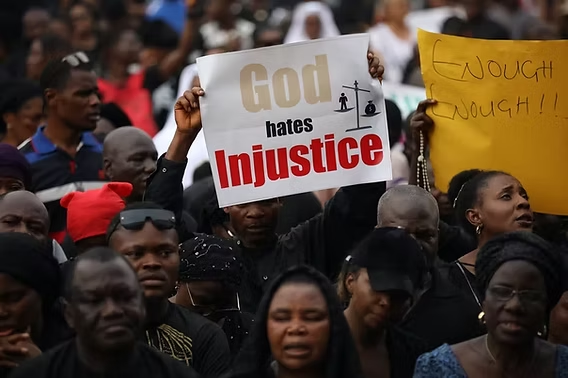
Author: Dian Harhar Pelawi
Student of International Relations, UNESA
Batch 2024
Humanitarian support across countries often comes with conditions shaped by who the victims are, who the perpetrators are, and what political interests are involved. For years, the international community has actively voiced solidarity for Palestine across borders. However, the same level of concern has not been shown toward Nigeria. This raises a critical question: why is humanitarian solidarity so inconsistent?

Roots and Chronology of Violence in Nigeria
Violence against Christians in Nigeria is not a sudden or isolated event. It is a long standing conflict rooted in a complex mix of religious, ethnic, and economic inequalities. Nigeria is the most populous country in Africa, with more than 200 million people, divided almost evenly between Muslims in the north and Christians in the south. Since gaining independence in 1960, these differences have frequently fueled political and social tensions, especially a mid competition over natural resources and increasingly limited agricultural land.
One of the most critical turning points occurred in the early 2000s with the emergence of Boko Haram in northeastern Nigeria in 2002. The name Boko Haram roughly translates to “Western education is sinful”. Initially formed as an anti-corruption religious movement, the group transformed in 2009 into a militant organization that strongly rejected Western influence and sought to establish an Islamic state in Nigeria.
According to Amnesty International, Boko Haram has been responsible for serious violations of civilian’s right to life since 2009. Estimates of death tolls vary depending on sources and methods of data collection. International institutions such as the United Nations and humanitarian organizations estimate that Boko Haram related violence has killed more than 35,000 to 40,000 people by the mid-2020s, the majority of whom were civilians. Meanwhile, conflict tracking organizations such as the Armed Conflict Location & Event Data Project (ACLED) and several regional think tanks suggest higher figures, ranging from 50,000 to 60,000 deaths by 2024–2025. These higher estimates include data on Boko Haram affiliates such as the Islamic State of West Africa Province (ISWAP) and indirect victims of violence. This discrepancy does not merely reflect statistical uncertainty, but rather highlights the complexity of the conflict and the lack of sustained international media attention and documentation.
Beyond Boko Haram, violence has also involved Fulani militias armed groups from Muslim pastoralist communities that frequently clash with Christian farmers in central and southern Nigeria. Although these conflicts are often framed as agrarian disputes, the reality on the ground reveals strong religious dimensions. Churches have been burned, villages attacked, and thousands of Christians displaced every year. According to Open Doors International (2024), more than 5,000 Christians were killed in Nigeria in just one year, making it the most dangerous country in the world for Christians.
Unfortunately, the Nigerian government has often failed to provide adequate protection. Security forces are frequently accused of responding slowly, and in some cases, of deliberate inaction. This situation has created a cycle of violence and impunity, where perpetrators are rarely held accountable while the number of victims continues to rise. In this context, the massacre of Christians in Nigeria should be recognized by the international community as a serious violation of the right to life and freedom of religion, two fundamental rights enshrined in the Universal Declaration of Human Rights (1948).
Human Rights Violations in Nigeria
The human rights violations occurring in Nigeria can be categorized as gross human rights violations, as they encompass civil, political, and fundamental rights guaranteed under international legal instruments. First, there is a clear violation of the right to life, as stipulated in Article 3 of the Universal Declaration of Human Rights (UDHR) and Article 6 of the International Covenant on Civil and Political Rights (ICCPR). Mass killings of civilians directly undermine the fundamental right to life and personal security.
Second, there are serious violations of freedom of religion and belief, guaranteed under Article 18 of the UDHR and Article 18 of the ICCPR, due to systematic discrimination and persecution based on religious identity. Such actions restrict individual's freedom to practice and uphold their beliefs.
Based on General Comment No. 36, the UN Human Rights Committee affirms that states retain full responsibility for protecting the right to life, even when threats originate from non state actors such as Boko Haram. Therefore, classifying the conflict as a domestic issue does not eliminate international human rights obligations. Moreover, a state’s failure to protect its citizens from armed group attacks constitutes a violation of human rights, as it contradicts the principle of state responsibility to protect, which obliges states to ensure the security and basic rights of all individuals within their territory.
Thus, under international law, the violations in Nigeria encompass the right to life, freedom of religion, protection of women and children, and crimes against humanity demonstrating a broader failure of the state to fulfill its human rights obligations.
Double Standard in Global Solidarity
The situation in Nigeria reveals that humanitarian concern often still carries religious and political bias. Global solidarity does not emerge in a vacuum nor as an automatic response to suffering; rather, it is shaped by religious narratives and political framing. In the case of Palestine, the issue has long been framed as a symbol of global Muslim suffering. Narratives of solidarity are deeply embedded in social media, religious sermons, and diplomatic discourse among Middle Eastern states. In contrast, the conflict in Nigeria has never received the same level of symbolic or emotional response. Violence there is frequently labeled as ethnic conflict or communal clashes rather than the massacre of Christians. As a result, what should be a universal humanitarian tragedy is reduced to a localized issue.
To test the claim of the universality of human rights often promoted in global discourse, it is necessary to examine how the international community actually responds to human rights violations in different conflict contexts. The comparison below highlights the imbalance in global attention and the selective nature of international solidarity toward humanitarian crises in Palestine and Nigeria.
Table: Comparison of Global Responses to Humanitarian Crises in Palestine and Nigeria
The data shows that Palestine receives broad diplomatic recognition, strong engagement from UN bodies, sustained humanitarian campaigns, and intense global media coverage. In contrast, responses to Boko Haram related violence in Nigeria remain limited, focusing mainly on security cooperation, declining humanitarian advocacy, and passive media coverage.
This imbalance suggests that the universality of human rights often functions more as normative rhetoric for diplomatic interests than as a consistently applied principle in global solidarity practices.
Although Boko Haram related violence in Nigeria has killed tens of thousands of civilians since 2009, it is largely treated as a domestic security issue rather than an international humanitarian crisis. As a result, it fails to receive sustained political, humanitarian, and media attention. Meanwhile, Palestine continues to be positioned as a critical international issue with strong political and symbolic meaning, triggering broader mobilization by states, international organizations, and global civil society.
This contrast indicates that responses to human rights violations are not determined solely by the scale of suffering, but by geopolitical framing, political interests, and the identity of victims within global narratives. The same principles, grounded in the same declarations, should generate equal responses. Yet reality shows that attention to human rights violations remains selective, influenced by conflict categorization and victim identity. Would international concern for Nigeria increase if the violence were framed as an international conflict rather than a domestic one? Human rights are meant to protect individuals not states and no scale of violence erases the obligation to protect every human life.
Ultimately, the tragedy in Nigeria tests the moral integrity of the modern world. If humanity truly upholds universal human values, then suffering whether in Gaza or Kaduna should provoke equal concern. Justice must not be selective, and empathy must not stop at identity boundaries. At its core, the right to life recognizes no religion or nationality. The distinction lies in whether we are willing to be truly human, or whether our humanity is reserved only for certain people.